What is a Lithium Polymer (Li-Poly) Battery?
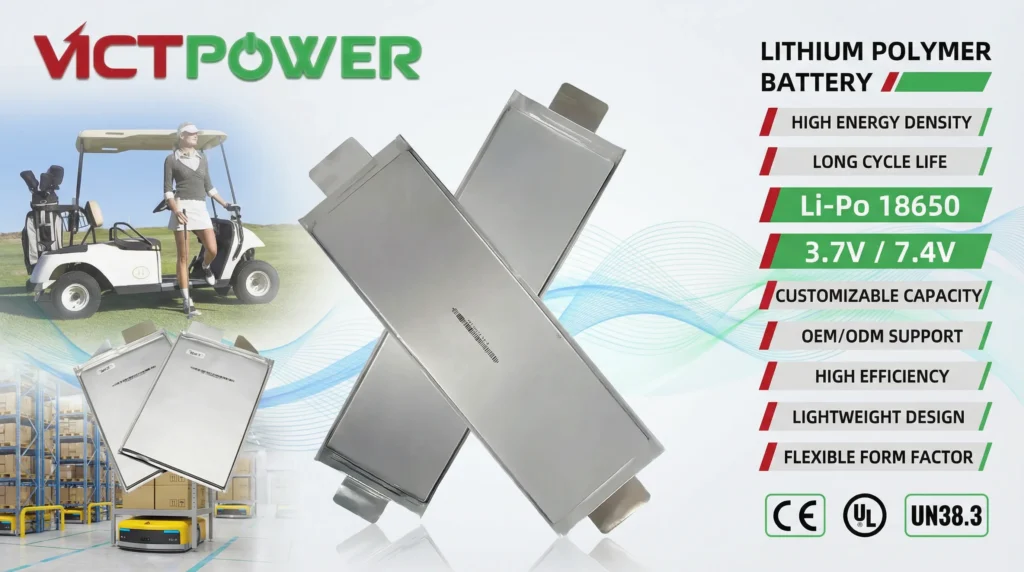
A lithium polymer (Li-Poly) battery, often referred to as a lithium-ion polymer battery, represents a significant advancement in rechargeable energy storage technology. Unlike traditional lithium-ion batteries that rely on liquid electrolytes held in a rigid metal case, Li-Poly batteries utilize a polymer electrolyte. This electrolyte can be a solid polymer, a dry polymer, or more commonly in modern commercial applications, a microporous gel-like substance.
This shift in chemistry allows for a fundamental change in battery architecture. By replacing the liquid electrolyte with a polymer gel, manufacturers like Victpower can eliminate the heavy, cylindrical metal casings required for standard 18650 cells. Instead, the battery components are laminated together and enclosed in a flexible, foil-like packaging. This design is widely known as the \”pouch cell\” format.
The Evolution of Battery Architecture
The transition from liquid to polymer electrolytes revolutionized how engineers design modern electronics. The pouch cell format offers distinct advantages that rigid cells cannot match:
- Design Flexibility: Manufacturers are no longer restricted to standard cylindrical shapes. Li-Poly cells can be manufactured in ultra-thin profiles (as thin as 1mm) or custom shapes to fit specific device cavities.
- Weight Reduction: The absence of a heavy steel can significantly reduces the overall weight of the battery pack, a critical factor for drones, RC aircraft, and portable wearables.
- Space Efficiency: Pouch cells can be stacked tightly without the wasted air gaps found between cylindrical cells, maximizing energy density within a limited footprint.
By leveraging lithium polymer li poly batteries, industries can achieve higher performance in lighter, more compact packages, driving innovation in everything from consumer electronics to industrial robotics.
Lithium Polymer vs. Lithium-Ion: Understanding the Differences
When clients approach us for power solutions, the decision often comes down to li poly vs li ion. While traditional cylindrical Lithium-Ion (Li-ion) cells are industrial workhorses, the lithium ion polymer battery offers specific advantages that define modern portable electronics. Understanding these distinctions is critical for selecting the right power source for your project.
Form Factor & Weight
The most immediate difference lies in the packaging. Standard Li-ion cells use a rigid metal case (like the 18650), which adds weight and restricts design. In contrast, lithium polymer li poly batteries utilize a laminated foil pouch. This \”soft pack\” design allows us to be a flexible custom lipo battery manufacturer, creating ultra-thin cells (under 1mm) or specialized shapes to maximize internal space in compact devices. You can explore our diverse range of battery products to see how these form factors differ in real-world applications.
Energy Density & Performance
For applications where every gram counts, such as drones or wearable tech, Li-Po is superior. These batteries typically offer a higher energy density per unit of weight compared to their steel-encased counterparts. This lightweight nature allows for longer runtimes in flight or mobile usage without weighing down the device.
Safety Profiles
Safety mechanisms differ significantly between the two chemistries.
- Li-Ion: Relies on a pressure valve. If internal pressure builds up due to failure, the hard case can vent, potentially causing thermal runaway if the valve fails.
- Li-Poly: The pouch design allows the cell to swell or \”puff\” if abused or overcharged. While a swollen battery must be retired immediately, this expansion is generally less violent than the rupture of a pressurized metal canister.
Cost & Manufacturing
Manufacturing lithium polymer li poly batteries is generally more complex, leading to slightly higher costs per watt-hour compared to automated cylindrical cell production. However, for premium products requiring high discharge rates and specific dimensions, the investment is necessary.
Quick Comparison: Li-Poly vs. Li-Ion
| Feature | Lithium Polymer (Li-Po) | Lithium-Ion (Li-ion) |
|---|---|---|
| Casing | Flexible Polymer Pouch | Rigid Metal Can |
| Weight | Lightweight | Heavier (due to metal case) |
| Shape | Customizable (Thin/Curved) | Fixed Cylindrical/Prismatic |
| Safety | Swells upon failure | Vents upon failure |
| Cost | Higher manufacturing cost | Lower mass-production cost |
Decoding Li-Po Battery Specifications
Understanding the numbers printed on a lithium polymer li poly battery is crucial for selecting the right power source for your device. These specifications dictate not just compatibility, but safety and performance. Let\’s break down the three most critical metrics: voltage, capacity, and discharge rate.
Voltage (V) & Cell Count (S)
The fundamental building block of any Li-Po pack is the individual cell. A single lithium ion polymer battery cell has a nominal voltage of 3.7V. To achieve higher voltages required for more powerful equipment, we wire these cells in series. This is where the \”S\” rating comes in—it simply tells you how many cells are in the series.
- 1S: 3.7V (Standard for small wearables)
- 2S: 7.4V (Common in transmitters and small RC cars)
- 3S: 11.1V (The standard for many drones and hobby aircraft)
- 4S: 14.8V (High-performance racing drones)
For example, a 3s lithium polymer battery consists of three 3.7V cells connected together, totaling 11.1V. It is vital to match the voltage of the battery to your device\’s motor or ESC (Electronic Speed Controller) requirements to avoid damaging components.
Capacity (mAh)
Capacity, measured in milliamp-hours (mAh), acts as the fuel tank of your battery. It tells you how much power the battery can hold. A higher mAh rating generally means a longer runtime.
| Capacity (mAh) | Estimated Runtime | Weight Impact |
|---|---|---|
| 1000mAh | Short | Very Light |
| 2200mAh | Medium | Moderate |
| 5000mAh+ | Long | Heavy |
While it might be tempting to always choose the highest capacity, remember that increased capacity adds physical weight and size. For applications like drones, finding the balance between flight time and weight is key.
Discharge Rate (C-Rating)
The C-Rating is often the most misunderstood specification, yet it is critical for high-performance applications. It represents the maximum safe continuous discharge rate of the battery.
- Calculation: Max Continuous Amps = Capacity (Ah) × C-Rating
- Example: A 2200mAh (2.2Ah) battery with a 20C rating can safely deliver: 2.2 × 20 = 44 Amps.
If your device draws more amps than the battery can deliver, the battery will overheat, puff up, and potentially fail. High-drain devices like racing drones or heavy-lift UAVs require high C-ratings to ensure the battery can keep up with the demand without stressing the chemistry. Always ensure your battery\’s discharge capability exceeds the maximum current draw of your system. For general maintenance and longevity, following top safety tips for your daily usage is essential to keep these high-performance cells operating safely.
Major Applications for Li-Poly Batteries
The versatility of lithium polymer li poly batteries has made them the go-to power source for industries requiring lightweight, high-performance energy solutions. Because we can manufacture these cells in soft pouches rather than rigid metal cans, we can fit power into spaces that traditional batteries simply cannot reach.
Consumer Electronics
In the world of consumer tech, every millimeter counts. Manufacturers constantly push for thinner, lighter devices without sacrificing battery life. The lithium ion polymer battery is the standard for this sector because of its flexible form factor.
- Smartphones & Tablets: Ultra-thin cells that maximize internal space.
- Wearables: Curved and small-format batteries for smartwatches and fitness trackers.
- Laptops: Flat, wide battery packs that maintain a slim profile.
UAVs and RC Hobbies
This is where raw power meets weight reduction. Drone lipo battery packs are essential for UAVs and RC aircraft because they offer an exceptional power-to-weight ratio. A heavy battery kills flight time, but a Li-Poly pack provides high energy density without the bulk.
- High Discharge Rates: Essential for the sudden bursts of power needed during takeoff or racing maneuvers.
- RC Vehicles: An rc car li poly battery delivers the high current needed for rapid acceleration and top speeds.
Medical & IoT Devices
As an industrial lipo battery supplier, we see a massive shift toward compact, portable medical equipment and Internet of Things (IoT) sensors. These devices often have irregular shapes or require batteries that fit into specific molded casings.
- Medical Portability: Powering handheld diagnostic tools and wearable health monitors.
- IoT Sensors: Long-lasting, custom-shaped cells for remote monitoring devices that need to operate reliably in various environments.
Essential Safety, Charging, and Storage Guidelines
As a manufacturer, we know that the performance of lithium polymer li poly batteries relies heavily on how they are treated. These cells are powerful, but they demand respect to operate safely and effectively. We integrate strict safety protocols into our manufacturing, but end-user handling is just as critical.
Best Practices for Charging
You cannot treat a Li-Poly pack like a standard household battery. Using the wrong charger is the number one cause of failure.
- Use a Balance Charger: For multi-cell packs, a balance charger is non-negotiable. It monitors the voltage of each individual cell to ensure they charge equally.
- Never Leave Unattended: Always charge your batteries on a fire-resistant surface and never leave them charging while you are away.
- Check Settings: Ensure your charger is set to the correct cell count and chemistry before hitting start.
Storage Voltage and Life Cycle
To get the best return on your investment and extend the lipo battery life cycle, proper storage is key. Leaving a battery fully charged (4.2V per cell) or completely drained for long periods degrades the internal chemistry.
- Storage Mode: If you aren\’t using the battery for more than a few days, bring it to a storage voltage of approximately 3.80V to 3.85V per cell.
- Temperature Control: Store your packs in a cool, dry place. Extreme heat is the enemy of lithium chemistry.
Handling Swollen Batteries
A swollen lipo battery is a serious safety warning. This \”puffing\” is caused by gas generation inside the sealed pouch, usually due to over-discharge, overheating, or physical damage.
- Do Not Use: If a pack is swollen, stop using it immediately.
- Do Not Puncture: Never try to release the gas by piercing the foil. This can cause an immediate fire.
- Safe Disposal: Move the battery to a fireproof location and follow local regulations for hazardous waste disposal.
For businesses looking to integrate these power sources safely, our engineering team designs custom battery solutions that include advanced Battery Management Systems (BMS) to automate protection against overcharging and short circuits.
Sourcing the Right Battery: Why Partner with Victpower?
When it comes to high-performance lithium polymer li poly batteries, precision is everything. As a premier manufacturer and supplier, we understand that off-the-shelf solutions often fail to meet the specific spatial and power demands of modern electronics. We bridge that gap by offering industrial-grade power solutions tailored to your exact specifications.
Expertise as a Custom Lipo Battery Manufacturer
We don\’t just sell cells; we engineer power systems. Our team specializes in the development of lithium ion polymer battery packs that maximize energy density while minimizing weight. Whether you are building next-generation UAVs or compact medical devices, we provide the technical backing to ensure your product performs reliably in the field.
Our core advantages include:
- Custom Engineering: We offer comprehensive custom battery pack assembly services to fit unique shapes, ultra-thin dimensions, or specific voltage requirements.
- Global Supply Chain: We maintain a robust inventory of original brand cells (Samsung, LG, Panasonic) and our own high-quality production lines to ensure consistent availability for bulk orders.
- Strict Quality Control: Every pack undergoes rigorous testing. We adhere to ISO9001 standards and ensure compliance with safety certifications like CE and UN38.3, giving you peace of mind regarding safety and durability.
If you have specific project requirements, you can submit your battery specifications directly to our engineering team. We work closely with you from the initial prototype phase through to mass production, ensuring your power solution is delivered on time and within budget.
Common Questions About Lithium Polymer Li Poly Batteries
What is the main difference between Li-Po and Li-ion batteries?
While both technologies rely on lithium ions to move energy, the lithium ion polymer battery utilizes a polymer electrolyte (often a gel) instead of the liquid electrolyte found in traditional cylindrical cells. This chemistry allows us to package the battery in a flexible, foil-type pouch. The result is a cell that is significantly lighter and can be manufactured in ultra-thin or custom shapes to fit tight device enclosures.
How do I choose the right C-rating for my application?
The C-rating indicates the continuous discharge capability of the battery.
- High C-Rating: Essential for high discharge lipo batteries used in racing drones or power tools that demand sudden, massive bursts of energy.
- Low C-Rating: Sufficient for steady, low-power devices like remote sensors or portable medical equipment.
Choosing the correct rating prevents voltage sag without overspending on unnecessary performance specs.
What causes a Li-Po battery to swell and how to prevent it?
Swelling, often called \”puffing,\” occurs when the electrolyte generates gas due to stress. The primary causes are overcharging, deep discharging below 3.0V per cell, or exposure to high heat. To prevent this, always use a quality charger with a balance function and ensure your battery pack includes a Battery Management System (BMS).
Can I mix different cell counts in a battery pack?
Absolutely not. You should never mix batteries of different capacities, brands, or usage levels. For instance, connecting a 3s lithium polymer battery (11.1V) with a 4s pack creates a dangerous voltage mismatch. This imbalance forces energy into the lower-voltage cells, leading to rapid overheating, permanent damage, or potential fire hazards.
How should I store Li-Po batteries for long periods?
If you are not using your batteries for more than a few days, do not leave them fully charged or fully depleted.
- Storage Voltage: Aim for approximately 3.80V to 3.85V per cell.
- Environment: Store them in a cool, dry place, ideally inside a fire-proof LiPo bag.
Storing a fully charged battery degrades its internal chemistry, shortening its lipo battery life cycle.
What makes Victpower a reliable custom lipo battery manufacturer?
We go beyond simple distribution. As a specialized custom lipo battery manufacturer, we combine Grade-A cells from top-tier brands (like Samsung, Panasonic, and LG) with our own precision assembly capabilities. We design packs with custom dimensions, connectors, and BMS protections tailored exactly to your industrial or commercial project. Contact our engineering team to secure a reliable power solution that meets global safety standards.