The Big Three Specs: Voltage, Amp-Hours, and Watt-Hours
Choosing the right electric bicycle battery isn\’t just about picking a shape that fits; it\’s about understanding the math behind the ride. When we design custom OEM/ODM packs at Victpower, we focus on three critical numbers that define your e-bike\’s performance. Understanding these specs ensures you get a battery that matches your motor and riding style perfectly.
Voltage (V) = Speed & Power
Voltage is the electrical pressure that drives the motor. Think of it as the horsepower of your system. Higher voltage generally means higher top speeds and better torque for climbing hills. We manufacture packs across the entire spectrum to match specific controller requirements:
- 36V: Ideally suited for entry-level city bikes. An electric bicycle battery 36v configuration offers smooth, manageable power for flat terrain.
- 48V: The current industry standard. A 48v electric bicycle battery (or 48 volt electric bicycle battery) provides the perfect balance of speed and torque for most commuters and mountain bikers.
- 60V – 72V: Designed for enthusiasts demanding raw power. Our 72v electric bicycle battery packs are built for high-performance motors, heavy-duty scooters, and motorcycles.
Amp-Hours (Ah) = Gas Tank Size
If voltage is your speed, Amp-Hours (Ah) represents your range. This number tells you how much energy is stored in the \”tank.\” A higher Ah rating means you can ride longer distances before needing a recharge. Whether you need a compact pack or a long-range endurance battery, we customize the capacity using high-density 18650 and 21700 cells to maximize run time without adding unnecessary bulk to the frame.
Watt-Hours (Wh) = Total Energy
To get the true picture of a battery for electric bicycle applications, you need to look at Watt-Hours. This is calculated by multiplying Voltage by Amp-Hours (V x Ah = Wh). Watt-Hours give you the most accurate comparison of total energy capacity across different voltage platforms, ensuring you get the exact range required for your specific riding needs.
Chemistry Matters: What’s Inside the Case?
When you open up an electric bicycle battery, you aren\’t just looking at a black box of energy; you are looking at a precise arrangement of chemical cells. The performance, safety, and lifespan of your e-bike depend entirely on the quality of these components. At Victpower, we don\’t cut corners on what goes inside the casing because we know that chemistry dictates reality on the road.
The Cells: Generic vs. Tier 1 Samsung/LG/Panasonic
The market is flooded with cheap packs using generic, no-name cells. These might look fine on a spec sheet, but they often suffer from significant voltage sag and poor cycle life. We take a different approach by prioritizing Tier 1 cells for our battery packs.
Using original Grade A cells from manufacturers like Samsung, LG, Panasonic, Sanyo, and Sony ensures consistency. A Samsung cell battery pack will reliably deliver its rated capacity and handle the discharge rates required by modern e-bike motors without overheating. We stick to proven 18650 and 21700 cell formats because they offer the best balance of energy density and reliability for global riders.
Chemistry Types: NCM vs LiFePO4
Choosing the right Lithium-ion e-bike battery pack also means selecting the right chemistry for your specific application. We generally work with two main types, each with distinct advantages:
- NCM (Nickel Cobalt Manganese): This is the standard for most lightweight e-bikes. It offers high energy density, meaning you get more range in a smaller, lighter package. For advanced applications requiring longevity, our Victpower 3.2V 8Ah NCM solid state battery technology pushes the boundaries of cycle life.
- LiFePO4 (Lithium Iron Phosphate): While slightly heavier, LiFePO4 is legendary for its safety and incredible cycle life. It is virtually incombustible and can handle thousands of charge cycles. For heavy-duty or commercial delivery e-bikes, a robust Victpower 32700 6Ah LiFePO4 battery cell configuration is often the superior choice for long-term value.
Quick Comparison:
| Feature | NCM (Li-ion) | LiFePO4 |
|---|---|---|
| Energy Density | High (Lighter weight) | Moderate (Heavier) |
| Cycle Life | 800 – 1000+ Cycles | 2000 – 4000+ Cycles |
| Safety | Good (Requires quality BMS) | Excellent (Chemically stable) |
| Best For | Commuters, MTBs, Road Bikes | Cargo Bikes, Delivery Fleets |
III. Form Factors: Finding the Right Fit for Your Frame
When sourcing an electric bicycle battery, the physical shape—or form factor—is just as critical as the voltage. A battery must seamlessly integrate with the bike\’s geometry to ensure stability, aesthetics, and safety. At Victpower, we manufacture a wide variety of casing styles to suit different e-bike designs, from sleek city commuters to rugged mountain bikes.
Downtube / Hailong Case
The Hailong battery case is the industry standard for conversion kits and many OEM e-bikes. It mounts directly to the water bottle eyelets on the downtube, keeping the center of gravity low for better handling. These cases are versatile, easily removable for charging, and typically support 36V, 48V, and 52V configurations. We often recommend this style for its balance of capacity and accessibility.
Rear Rack Battery
For step-through frames or bikes where downtube space is limited, the rear rack battery is the go-to solution. These packs slide into a dedicated rack above the rear wheel. While this shifts weight backward, it allows for larger capacity packs, often used in touring or cargo bikes. Many of our rear rack designs include integrated taillights for added safety.
Silver Fish Battery Case
The Silver Fish battery is a classic design, often found on folding bikes and older e-bike models. It is a tall, vertical aluminum casing that usually sits behind the seat post. This robust design offers excellent protection for the cells inside and is favored for its durability in urban environments.
Integrated/In-Frame Batteries
Modern e-bikes increasingly use integrated batteries that hide inside the frame tubing for a clean, stealthy look. These packs require precise engineering to fit specific frame cavities. We specialize in creating slim, high-density packs using 21700 or 18650 cells that maximize range without adding bulk to the bike\’s profile.
Victpower Custom Casings
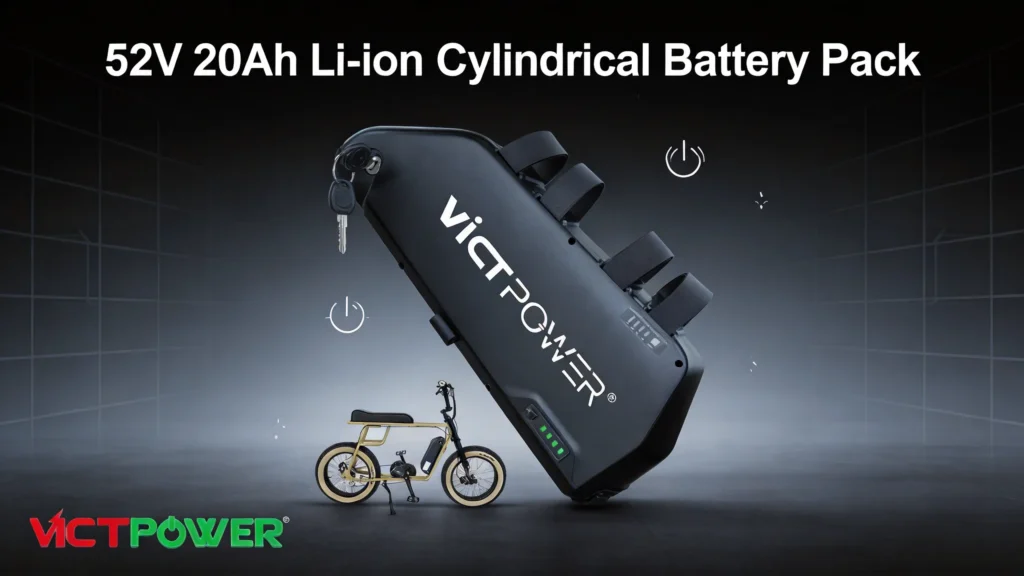
As an OEM/ODM manufacturer, we don\’t just stick to off-the-shelf molds. We work with clients to build custom e-bike battery packs tailored to unique frame designs. Whether you need a specific shape for a triangle cylindrical design or a completely new housing, our R&D team ensures the casing provides adequate thermal management and vibration resistance.
Key Considerations for Form Factors:
- Mounting Points: Ensure the frame has the necessary eyelets or space.
- Clearance: Check for interference with suspension components or rider movement.
- Removal Mechanism: Easy-release keys are essential for security and charging convenience.
- Material: We use durable ABS+PC or aluminum alloys to withstand impact.
IV. Safety First: The Importance of BMS and Certification
When you are out riding, the stability of your power source should be a guarantee, not a gamble. Safety is the absolute cornerstone of a high-quality electric bicycle battery. We do not cut corners on safety; we engineer reliability directly into every pack we manufacture to ensure peace of mind for riders and distributors alike.
Battery Management System (BMS) Protection
Think of the BMS as the intelligent brain of the battery pack. It is non-negotiable for lithium safety. We integrate high-performance BMS units into every custom solution to constantly monitor cell health in real-time. This system actively prevents common failures that can lead to permanent damage or safety hazards:
- Overcharge Protection: Automatically stops current once cells reach maximum voltage.
- Over-discharge Protection: Prevents the battery from draining beyond a safe recovery level.
- Short Circuit Prevention: Instantly cuts power output if an electrical fault is detected.
- Thermal Management: Monitors temperatures to prevent overheating during rapid charging or hard riding.
UN38.3 and Other Certifications
Compliance is critical for global trade. You cannot legally ship or sell lithium batteries internationally without proper documentation. Our manufacturing process adheres to rigorous international standards, ensuring our packs are safe for logistics and end-users. We maintain active compliance with key industry standards:
- UN38.3: Essential certification required for the safe shipping and transport of lithium goods.
- UL & CE: Critical safety standards required for entry into North American and European markets.
- RoHS: Ensures our manufacturing minimizes hazardous substances.
- ISO9001:2015: Verifies that our quality management systems meet global benchmarks.
Victpower’s Factory Quality Tests
Certification is the paperwork; performance is the reality. Before any of our battery products leave the facility, they undergo strict testing protocols. We utilize original Grade A cells from top-tier suppliers like Samsung, LG, and Panasonic to ensure consistency from the start.
Our internal factory testing includes:
- Capacity Grading: Ensuring every cell matches the rated specifications.
- Aging Tests: Simulating usage cycles to verify longevity.
- Vibration Testing: Ensuring internal connections can withstand the bumps of the road.
V. Connector Types: Don\’t Get Unplugged
Even the most powerful electric bicycle battery is useless if it cannot reliably deliver energy to your motor. The interface between your battery pack and the controller is critical for both safety and efficiency. A loose or mismatched connection creates resistance, which leads to heat buildup and potential power failure during a ride.
Common Connectors: Anderson, XT60, and XLR
At Victpower, we encounter a wide variety of plugs depending on the specific application and region. Here are the standards we frequently install on our packs:
- Anderson Powerpole: These are modular, genderless, and versatile. They are excellent for high-current applications because the contacts are self-cleaning and maintain a tight connection even under heavy vibration.
- XT60 and XT90: Instantly recognizable by their yellow nylon casing. These are industry favorites for high-performance builds because they handle high amps without melting. The XT90 often includes an anti-spark feature, which is crucial for higher voltage systems like a 48v electric bicycle battery or 72v electric bicycle battery.
- Bullet and XLR: These are commonly found on charging ports or lighter-duty discharge cables for lower-power city bikes.
Matching Connectors to Your Motor Controller
One of the biggest headaches for buyers is receiving a battery with the wrong plug. You should never have to cut wires and solder new ends on a brand-new factory pack.
As part of our custom battery solutions, we configure the discharge and charging ports to match your specific motor controller or fleet requirements exactly. Whether you require a waterproof aviation plug for a battery for electric bicycle fleets or a standard Anderson connector for a conversion kit, we ensure the unit is plug-and-play ready right out of the box.
Maintenance Tips: Extending Your Electric Bicycle Battery Life
As a manufacturer with over 15 years of experience, we know that the lifespan of an electric bicycle battery depends heavily on how it is treated. While we build our packs with Grade A cells and robust protection systems, following a few simple maintenance rules will ensure you get the maximum cycle life out of your investment.
Smart Charging Habits
Proper charging is the easiest way to protect your Lithium-ion e-bike battery pack.
- Avoid Deep Discharge: Try not to drain your battery to 0% regularly. Lithium chemistry prefers partial discharges and top-ups.
- Cool Down First: Never charge a hot battery immediately after a long ride. Let it cool to room temperature first.
- Use the Correct Charger: Always use the charger designed for your specific voltage (e.g., 48V or 36V) and chemistry to prevent damage.
Temperature Considerations
Batteries are sensitive to extreme environments. To maintain the health of your 48V electric bicycle battery:
- Avoid Extreme Heat: High temperatures degrade battery chemistry faster than anything else. Don\’t leave your bike or battery in direct sunlight for extended periods.
- Winter Storage: If you ride in the cold, bring the battery inside to charge. Freezing temperatures can significantly reduce range and charging efficiency.
Cleaning and Long-Term Care
Keeping your battery clean ensures safety and reliability.
- Keep Contacts Clean: Regularly check the discharge ports and connectors (like Anderson or XT60) for dirt or corrosion.
- Dry Storage: Moisture is the enemy. Ensure your casing is dry before storage.
- Storage Voltage: If you aren\’t using the bike for a month or more, store the battery at roughly 50-60% charge, not fully charged or fully empty.
For businesses looking to develop maintenance protocols for large fleets or custom projects, our specialized battery services can help you design solutions that prioritize longevity and safety.
VII. FAQs about Electric Bicycle Batteries
Which voltage battery fits my e-bike?
Matching voltage is critical for system compatibility. If your controller and motor are rated for 36V, you must use an electric bicycle battery 36V. Using a higher voltage, like a 48V electric bicycle battery, on a 36V system can fry your controller. Conversely, using a lower voltage will result in insufficient power to drive the motor. Always check the label on your motor controller before ordering.
How to increase e-bike range safely?
Range depends heavily on capacity (Amp-Hours). To go further, upgrade to a battery with higher Ah ratings, such as moving from a 10Ah to a 48V 20Ah battery range. Ensure the physical dimensions still fit your frame. Additionally, maintaining proper tire pressure and using pedal assist instead of full throttle significantly extends the life of a single charge.
Are Tier 1 cells worth the cost?
Absolutely. We prioritize using original Grade A cells from manufacturers like Samsung, LG, Panasonic, and Sanyo in our packs. Generic cells often exaggerate capacity and degrade quickly. A Samsung cell battery pack offers consistent performance, better safety stability, and a longer cycle life, making it a better long-term investment than cheaper alternatives.
What certifications ensure battery safety?
Safety is non-negotiable for lithium batteries. Look for packs that meet international standards. Our factory ensures compliance with UN38.3 battery certification for safe transport, along with UL, CE, and RoHS standards. These certifications verify that the battery has passed rigorous testing for impact, vibration, and thermal shock.
How to identify a waterproof battery?
While few batteries are 100% submersible, good waterproof e-bike battery designs feature sealed casings (like the Hailong or Silver Fish models) and silicone-sealed BMS connections. Check the IP rating; IP65 or higher is recommended for riding in rain. We design our casings to protect internal components from moisture ingress during standard riding conditions.
Can I build a custom e-bike battery pack?
Yes, customization is our specialty. Whether you need a specific shape for a unique frame or a high-power 72V electric bicycle battery for performance riding, we provide OEM/ODM services. You can contact our engineering team to discuss specific dimensions, cell types (18650 vs 21700), and BMS requirements for your custom build.