Deconstructing the Specifications: What 750mAh & 3.7V Mean for Performance
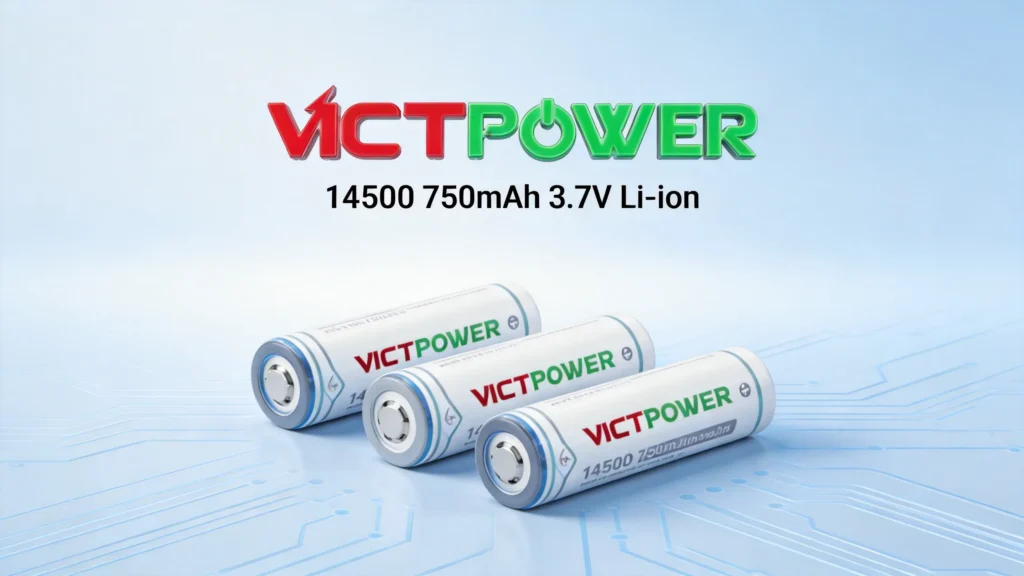
Understanding the core metrics of a li-ion cylindrical cell 14500 750mAh 3.7V is essential for selecting the right power source for your application. While the 14500 form factor shares physical dimensions with a standard AA battery (14mm diameter x 50mm height), the internal chemistry and performance capabilities are vastly different.
Voltage Matters: 3.7V vs. 1.5V
The most critical distinction lies in the nominal voltage. A standard alkaline AA battery operates at 1.5V, whereas a 14500 lithium-ion cell delivers a nominal 3.7V.
- Energy Density: The higher voltage allows a single 14500 cell to replace up to three alkaline cells in series in specific custom circuit designs, saving significant space and weight.
- Device Compatibility: This voltage difference means you cannot simply swap a 14500 into a device built strictly for 1.5V alkaline batteries without risking immediate circuit damage due to over-voltage.
Capacity Deep Dive: 750mAh
The 750mAh rating represents the milliamp-hour capacity, indicating how much electric charge the battery can deliver at a specific voltage over one hour.
- Real-World Runtime: In a device drawing 750mA, this cell would theoretically last one hour. For lower-drain IoT sensors drawing 75mA, the runtime extends to approximately 10 hours.
- Efficiency: Compared to older chemistries, this capacity offers a balanced trade-off between runtime and the physical constraints of the 14500 size, ensuring reliable power for compact electronics.
Discharge Rates and Performance
Not all 750mAh cells are created equal; the discharge rate (C-rate) determines how fast energy can be pulled from the cell.
- Standard Discharge: Most standard 14500 cells are designed for low to medium drain applications (0.2C to 1C).
- High Drain: Specialized cells can handle higher currents for devices like high-lumen flashlights or motorized toys.
| Specification | Value | Impact on Application |
|---|---|---|
| Nominal Voltage | 3.7V | High power output; not directly compatible with 1.5V devices. |
| Capacity | 750mAh | Optimized for compact, medium-drain electronics. |
| Chemistry | Li-ion | Rechargeable, no memory effect, high energy density. |
| Cut-off Voltage | 2.75V – 4.2V | Requires precise BMS management to prevent over-discharge. |
Critical Applications: Where is the 14500 750mAh Li-ion Cylindrical Cell Used?
The li-ion cylindrical cell 14500 750mah 3.7v is the go-to power source for devices that need more punch than a standard AA alkaline can provide. Because it shares the same physical dimensions as a AA battery but operates at a much higher voltage, it bridges the gap between portability and high-performance output.
Consumer Electronics & Personal Care
In the consumer market, this high drain 14500 cell is a staple for high-end gear. It provides the sustained current necessary for:
- Professional LED flashlights that require high lumen output.
- Electric shavers and trimmers where motor speed consistency is key.
- High-performance RC controllers and handheld gaming peripherals.
Smart Home & IoT Integration
As homes become more connected, the demand for reliable, long-lasting power grows. Our 14500 cells are integrated into wireless sensors and security hardware, contributing to smart ways to save energy at your home by powering efficient, low-latency communication modules.
- Smart locks and biometric entry systems.
- Wireless security cameras and motion detectors.
- Environmental sensors for HVAC optimization.
Industrial & Custom Packs (B2B Focus)
For my B2B clients, the 14500 cell is a versatile building block. We specialize in lithium-ion battery pack assembly, configuring these cells into series or parallel strings to meet specific voltage and capacity requirements for specialized equipment. Many industrial designers choose our custom lithium battery solutions for medical devices, handheld scanners, and portable testing equipment where space is at a premium but reliability is non-negotiable.
Technical Variations: Flat Top, Button Top, and Solder Tabs
When you are sourcing a li-ion cylindrical cell 14500 750mah 3.7v, you quickly realize that \”one size fits all\” doesn\’t apply here. The internal chemistry might be the same, but the physical termination—how the battery connects to your device—changes everything. At Victpower, we customize these terminations to fit specific manufacturing needs.
Physical Connections: Getting the Fit Right
The most obvious difference is the positive terminal. It sounds simple, but choosing the wrong one means your device won\’t power on, or the battery won\’t fit.
- Button Top: This looks like a standard AA alkaline battery with a protruding positive pole. These are essential for consumer devices (like flashlights) where batteries are inserted in series. The \”button\” ensures contact between the positive end of one cell and the negative end of the next.
- Flat Top: As the name suggests, the positive end is flat. These are slightly shorter than button tops. We primarily supply these for battery pack assembly or devices with spring-loaded contacts designed specifically for flat tops. If you try to put these in a standard flashlight, they often won\’t make contact.
- Solder Tabs: For industrial applications, we weld nickel tabs directly onto the terminals. This is strictly for manufacturing custom packs or permanent installation into devices like electric shavers or solar lights. You should never try to solder directly onto a battery terminal yourself—the heat can damage the internal safety seals. Let us handle the tab welding.
Protected (PCB) vs. Unprotected Cells
This is the most critical safety distinction. A PCB protected li-ion battery includes a small circuit board, usually integrated into the bottom or top of the cell.
| Feature | Protected (PCB) 14500 | Unprotected 14500 |
|---|---|---|
| Safety Mechanism | Built-in circuit prevents over-charge, over-discharge, and short circuits. | No internal electronic safety; relies on the device\’s external BMS. |
| Size (Length) | Slightly longer (approx. 52-53mm) due to the added board. | Standard 50mm length. |
| Best Use Case | Consumer electronics (flashlights, toys) where the user handles loose cells. | OEM battery pack assembly, custom industrial packs, and devices with their own protection circuits. |
| Cost | Higher manufacturing cost. | Lower cost per unit. |
For most B2B clients building custom packs, we recommend unprotected cells because your pack will have its own dedicated Battery Management System (BMS). However, if you are selling individual cells directly to consumers for general use, a protected cell is non-negotiable for safety.
Safety and Charging Best Practices for 14500 Cells
Handling high-energy density lithium batteries requires strict adherence to safety protocols to ensure longevity and prevent hazards. As a manufacturer, we prioritize educating our clients on the correct usage of the li-ion cylindrical cell 14500 750mah 3.7v to maintain optimal performance in consumer and industrial applications.
Charging Protocol
The standard charging method for these cells is Constant Current/Constant Voltage (CC/CV). Using an improper charger can lead to overcharging, thermal runaway, or reduced cycle life.
- Max Charging Voltage: The limit must be strictly set to 4.2V ± 0.05V. Exceeding this can damage the internal chemistry.
- Standard Current: We recommend charging at 0.5C (approx. 375mA for a 750mAh cell) for the best balance between speed and battery health.
- Cut-off: Charging should terminate when the current drops below a specific threshold (usually 0.01C or 0.02C) during the CV phase.
Proper Storage Guidelines
If you are warehousing inventory or not using the batteries immediately, storage conditions are critical. Storing a rechargeable lithium battery AA size equivalent at full charge for long periods accelerates degradation.
- State of Charge (SoC): Store cells at approximately 40-50% charge (roughly 3.8V).
- Temperature: Keep in a cool, dry environment, ideally between 15°C and 25°C.
- Inspection: For long-term storage, check the voltage every 3-6 months and top up if it drops below 3.0V to prevent sleep mode or permanent damage.
Victpower Quality Control
Our manufacturing process integrates rigorous testing to ensure every cell meets global safety standards like UN38.3 battery certification. We don\’t just assemble; we engineer reliability.
- Automated Sorting: We sort cells by voltage and internal resistance to ensure consistency, which is vital for lithium-ion battery pack assembly.
- Safety Testing: Our protocols include drop tests, thermal shock tests, and short-circuit protection verification.
- Traceability: We maintain strict batch tracking to monitor quality from raw materials to the final shipment.
For businesses looking to integrate these cells into larger systems, our engineering team offers comprehensive solutions for custom battery management systems (BMS) and pack designs.
Sourcing for Manufacturing: The Victpower Advantage
When you\’re scaling production, the reliability of your li-ion cylindrical cell 14500 750mah 3.7v supply chain is everything. I focus on providing a direct line to the factory, eliminating middlemen and ensuring that every cell meets strict performance benchmarks for your specific application.
OEM/ODM Capabilities and Custom Packs
We don\’t just ship loose cells. My team specializes in custom lithium battery solutions, taking the 14500 750mAh cell and integrating it into sophisticated packs tailored to your device\’s footprint.
- Precision Spot Welding: Custom nickel tabs for seamless PCB integration.
- BMS Integration: Adding protection circuits (PCM/BMS) for safety and longevity.
- Plug-and-Play Connectors: Wiring harnesses pre-installed for rapid assembly.
Why Buy Direct from the Manufacturer?
Buying your li-ion cylindrical cell 14500 750mah 3.7v directly from us offers advantages that a trading company cannot match. As a leading OEM battery manufacturer in China, I ensure that our 14500 cells arrive with the certifications needed for global export, including UN38.3 and MSDS.
| Advantage | Benefit to Your Business |
|---|---|
| Direct Pricing | Lower bill of materials (BOM) costs for your project. |
| Traceability | Full batch tracking from raw materials to finished cell. |
| Technical Support | Direct access to engineers for 14500 discharge curve data. |
| Scalability | Much like our high-volume 32700 lithium-ion cells, we handle massive orders with ease. |
Consistency and Quality Control
Consistency is where most suppliers fail. At Victpower, we maintain tight control over internal resistance 14500 metrics to ensure balanced performance across large batches. We regularly publish updates on our testing protocols and manufacturing standards in our battery industry blogs to keep our partners informed about the latest lithium-ion advancements. This transparency ensures that the first cell in your order performs exactly like the last.
Frequently Asked Questions About 14500 750mAh Cells
Can I Replace AA Alkaline with 14500 Li-ion Directly?
This is the most common question we get, and the short answer is usually no. While a li-ion cylindrical cell 14500 750mah 3.7v shares the exact same physical dimensions as a standard AA alkaline battery, the voltage difference is massive. A standard AA outputs 1.5V, whereas our 14500 cell outputs a nominal 3.7V (and up to 4.2V when fully charged). Putting a 3.7V battery into a device designed strictly for 1.5V will likely fry the circuit board instantly. You should only use 14500 cells in devices specifically rated for high-voltage lithium inputs, such as high-performance LED flashlights or specific industrial equipment.
What Are the Risks of Using Unprotected 14500 Cells?
Unprotected cells are raw batteries without an integrated Protection Circuit Board (PCB). These are primarily designed for industrial use where they will be spot-welded into a larger battery pack that has its own Battery Management System (BMS). If you use an unprotected cell as a standalone battery, you risk:
- Over-discharge: Draining the battery below 2.5V, which can permanently kill the cell.
- Short Circuits: High current flow without a safety cut-off can lead to overheating or venting.
- Over-charging: Exceeding 4.2V can cause thermal runaway.
For consumer applications, we almost always recommend a PCB protected li-ion battery to prevent these issues.
How Do I Identify Button Top vs Flat Top 14500 Cells?
The difference lies in the positive terminal (cathode).
- Button Top: Features a protruding metal nipple, similar to a standard consumer AA battery. These are required for most series connections (stacking batteries) and consumer devices like flashlights to make proper contact.
- Flat Top: The positive end is flush with the casing. These are slightly shorter and are designed for manufacturing custom battery packs where nickel strips are spot-welded directly to the terminals.
What Chargers Are Safe for 14500 Batteries?
You must use a charger specifically compatible with 3.7V rechargeable battery charger protocols (CC/CV – Constant Current/Constant Voltage). Never put a 14500 lithium-ion battery into a charger designed only for NiMH (Nickel-Metal Hydride) or NiCd batteries. Doing so is dangerous because the charging algorithms are completely different. A proper smart charger will automatically detect the chemistry and stop charging once the cell hits 4.2V.
How Does Victpower Ensure Quality and Safety?
We take safety seriously because we know our clients rely on consistent power. Every batch of cells undergoes rigorous testing before leaving our factory. We perform capacity grading, internal resistance testing, and voltage matching to ensure uniformity. Furthermore, our products comply with major international safety standards, including UN38.3 battery certification, which is required for the safe transport of lithium batteries. This ensures that whether you are shipping by air or sea, the cells meet global safety requirements.
Can I Get Custom Battery Packs Using 14500 Cells from Victpower?
Absolutely. While we supply individual cells, a large part of our business involves creating tailored power solutions. We can assemble 14500 cells into packs of various voltages and capacities, complete with the necessary BMS, wiring, and connectors. If you have specific requirements for a project, you can explore our OEM/ODM services to see how we can engineer a pack that fits your device perfectly. We handle everything from the initial design to the final shrink-wrapping and testing.