Why Homeowners Are Switching to Battery Energy Storage
As we look at the current landscape of residential energy, it is clear that the conversation is just beginning. Right now, many homeowners are landing on the idea of energy independence, much like arriving at a fresh, new starting point.
Real Energy Security: Backup Power Essentials
For many, the journey starts with the basic need for stability. When the grid goes down, the immediate value of a battery energy storage system for home becomes obvious. It is about establishing a reliable foundation. Just as a new website starts with a simple \”Hello world!\” to signal it is live and ready, a home battery signals that your household is ready to operate regardless of external conditions. It is the first step in building a resilient power infrastructure for your family.
Financial ROI: Peak Shaving & Time-of-Use (TOU)
Beyond security, the economics of energy storage are driving interest. While the initial setup might seem like a blank slate, the potential for managing costs is significant.
- Strategic Usage: By storing energy when rates are low and using it when rates are high, you effectively manage your energy budget.
- Future-Proofing: Investing now prepares you for a future where energy flexibility is key.
Just as we are currently in the early stages of February 2026 in our digital presence, the financial planning for home energy is about looking forward and preparing for what comes next.
Solar Self-Consumption: Maximizing Your Green Energy
If you have solar panels, a battery is the logical next step. It ensures that the energy you generate doesn\’t just disappear back into the grid but stays with you. It transforms a simple setup into a robust system. We are currently focused on building out these capabilities, ensuring that every kilowatt-hour you produce serves a purpose in your home.
The Heart of the System: Chemistry Matters
The Shift to Lithium Iron Phosphate (LiFePO4)
When choosing a battery energy storage system for home, the most critical decision isn\’t just the brand—it\’s the chemistry inside the box. For years, the industry relied on heavy lead-acid units or volatile cobalt-based mixtures. Today, we are seeing a decisive shift toward LiFePO4 battery chemistry. This isn\’t just a trend; it is the new standard for residential energy independence. Homeowners are moving away from older technologies because they demand systems that are lighter, more efficient, and capable of handling deep discharge cycles without degrading rapidly.
Safety First: Thermal Stability & Fire Risks
Safety is the number one concern for any equipment installed in a living space. The primary advantage of LiFePO4 over other lithium-ion chemistries (like NMC) is its superior thermal stability. In simple terms, the chemical bond is stronger, making it extremely resistant to thermal runaway.
- High Flashpoint: These batteries can withstand much higher temperatures without catching fire.
- Structural Integrity: Even if punctured or stressed, the risk of combustion is significantly lower compared to cobalt-based alternatives.
- Peace of Mind: For families, this means storing energy without the constant worry of fire hazards associated with older battery tech.
Longevity: Cycle Life Expectations (LiFePO4 vs. Lead-Acid)
The financial value of a storage system is directly tied to how long it lasts. This is where the comparison between traditional lead-acid and modern lithium becomes stark. A standard lead-acid battery might give you 300 to 500 cycles before it needs replacing—that is barely a year or two of daily use.
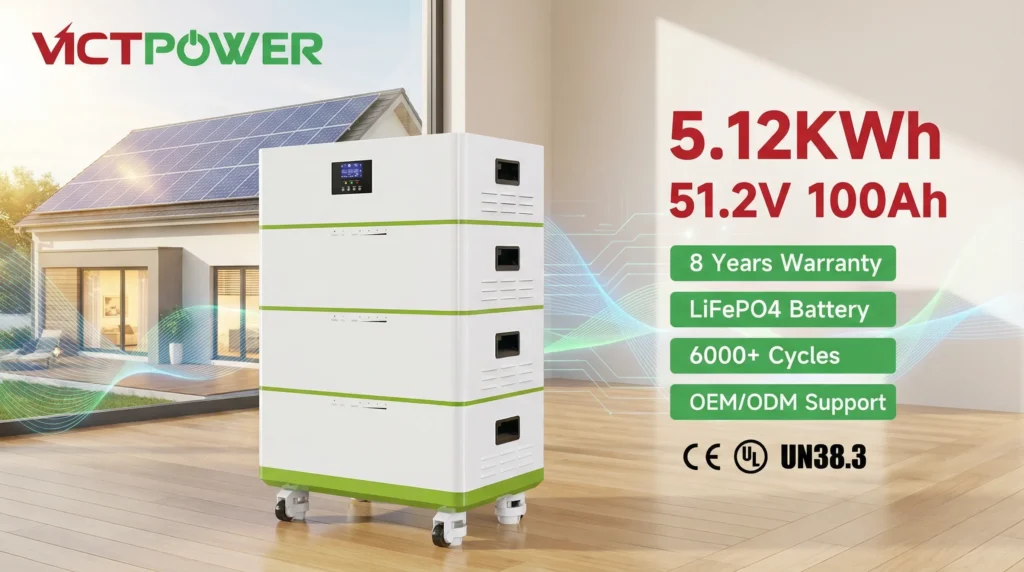
In contrast, a high-quality LiFePO4 battery is built for the long haul. We are looking at lifespans that often exceed 4,000 to 6,000 cycles at 80% depth of discharge. For homeowners looking for reliability, an OEM 200Ah BMS LiFePO4 deep cycle battery pack offers the durability needed for daily cycling, ensuring you aren\’t swapping out expensive components every few years. You buy it once, and it works for a decade.
Key Technical Specs for Your Battery Energy Storage System
When selecting a battery energy storage system for home, understanding the technical specifications is crucial to ensuring you get the right setup for your needs. It’s not just about buying a big battery; it’s about understanding how that energy is stored and delivered.
Power (kW) vs. Capacity (kWh): The Bucket Analogy
Many homeowners confuse power and capacity. Think of your battery system like a bucket of water with a spout at the bottom.
- Capacity (kWh): This is the size of the bucket. It measures the total amount of energy the battery can store. A higher kilowatt-hour (kWh) rating means you can run your appliances for a longer duration.
- Power (kW): This is the size of the spout. It measures how fast the energy can be released at any given moment. A higher kilowatt (kW) rating allows you to run more high-demand appliances simultaneously, like an air conditioner and a dryer.
| Specification | Unit | What It Means for You |
|---|---|---|
| Capacity | kWh | How long your backup power lasts. |
| Power | kW | How much you can run at once. |
Depth of Discharge (DoD) Explained
Depth of Discharge (DoD) refers to the percentage of the battery that has been discharged relative to its total capacity. Most modern systems allow for a high DoD, meaning you can use more of the stored energy without damaging the unit. For example, if a 10 kWh battery has a DoD of 90%, you can safely use 9 kWh of energy. A higher DoD generally indicates a more efficient and usable battery technology.
Round-Trip Efficiency: Keeping the Energy You Store
Round-trip efficiency measures the percentage of electricity put into storage that is later retrieved. No system is 100% efficient; some energy is always lost during the conversion process from DC to AC and back. A higher round-trip efficiency means you waste less energy during these cycles, ultimately providing better value for your stored solar power or grid energy. While focusing on efficiency, it is also important to adopt smart ways to save energy at your home to maximize the benefits of your storage system.
The Brains: Battery Management System (BMS)
When we talk about a battery energy storage system for home, the cells store the power, but the Battery Management System (BMS) is the actual brain of the operation. Without a high-quality BMS, a battery is just a collection of chemicals waiting to fail. I always emphasize that the BMS is the single most critical component for longevity and performance. It constantly monitors the state of every single cell in the pack, ensuring they charge and discharge evenly. This balancing act prevents one weak cell from dragging down the entire system\’s performance.
How Smart BMS Protects Your Home
Safety is non-negotiable in residential settings. A Smart BMS acts as your 24/7 security guard, protecting your property against potential hazards like overcharging, deep discharging, and short circuits. If the system detects a temperature spike or irregular voltage, it instantly cuts the circuit to prevent damage or thermal incidents.
This level of protection is similar to how upgrading electrical panels safeguards your home\’s broader electrical infrastructure; the BMS does the same specifically for your energy storage.
Key protective functions include:
- Thermal Management: Monitors internal temperatures to prevent overheating.
- Overcurrent Protection: Stops excessive current that could damage cells.
- Voltage Balancing: Ensures all cells stay within safe operating limits.
Communication Protocols: Inverter Compatibility
A battery doesn\’t work in isolation; it has to \”talk\” to your inverter to manage energy flow efficiently. This is where communication protocols come into play. A superior BMS supports standard protocols (like CAN bus or RS485) to ensure seamless data exchange with the hybrid inverter.
When the battery energy storage system for home communicates effectively, the inverter knows exactly how much charge is available and when to pull from the grid or solar panels. If the communication fails, the system becomes inefficient or stops working entirely. We ensure that the BMS is compatible with major inverter brands to guarantee a plug-and-play experience rather than a troubleshooting nightmare.
Installation Scenarios: Grid-Tied vs. Off-Grid
Choosing the right setup for your battery energy storage system for home depends entirely on your existing infrastructure and energy goals. Whether you are looking to cut ties with the utility company completely or just want a safety net during outages, the installation method dictates performance.
Retrofit Solutions: AC Coupling for Existing Solar
If you already have solar panels installed, you don\’t need to rip out your old inverter. AC coupling is the standard retrofit solution. In this scenario, we install a battery inverter alongside your existing solar inverter. The solar energy is converted to AC power for your home first, and any excess is converted back to DC to charge the battery. It’s a slightly less efficient path due to the double conversion, but it is the most cost-effective way to add storage to a functioning solar array without rewiring the whole system.
New Installations: DC Coupling & Hybrid Inverters
For a brand-new setup, DC coupling is the superior choice. We use a hybrid inverter that manages both the solar panels and the battery storage simultaneously. The DC power from the panels flows directly into the battery without being converted to AC first. This reduces energy loss significantly, ensuring you capture more of what you generate. A hybrid inverter simplifies the system architecture, reducing the number of components on your wall and streamlining maintenance.
Scalability: Modular Systems for Future Expansion
Energy needs change over time—maybe you buy an EV or build an addition to your home. You shouldn\’t be locked into a static capacity. Modern energy solutions prioritize modularity. We design systems where battery modules can be stacked or added in parallel. You might start with a 5kWh unit to cover essential lights and internet, and later expand to 20kWh to run heavy appliances. This \”pay-as-you-grow\” approach prevents over-investing upfront while keeping your path to total energy independence open.
Evaluating Manufacturers: The Factory-Direct Advantage
Buying a battery energy storage system for home is a major investment, and where you get it matters as much as the specs. I’ve found that working directly with the manufacturer is the only way to avoid the middleman markup that usually inflates retail prices by 30% or more. Beyond cost, the factory-direct model gives you a direct line to technical expertise and better quality control over the LiFePO4 battery chemistry inside your unit.
Customization: OEM/ODM Solutions
No two homes are identical, and neither are their energy needs. We provide custom battery solutions that allow for tailored capacities and specific branding requirements. Whether you are looking for a specific aesthetic to match your home or need unique hybrid inverter compatibility, our OEM/ODM services ensure the hardware is built to your exact project specifications rather than a one-size-fits-all approach.
Essential Safety Certifications
When you’re putting high-capacity energy storage in a garage or utility room, safety is the top priority. I ensure every system we produce carries the industry’s most rigorous \”gold standard\” certifications:
- UL 1973: The critical standard for batteries used in stationary applications like solar-plus-storage.
- UN38.3: Guarantees the battery remains stable and safe during international shipping and handling.
- CE Mark: Ensures the system meets all health and safety requirements for the global market.
By sticking to these verified standards, you get residential energy independence without compromising on thermal runaway protection or long-term reliability. Source smart, source direct, and make sure the paperwork backs up the performance.
FAQ: Common Questions About Home Battery Systems
How long will a 10kWh battery run my house?
The runtime of a battery energy storage system for home depends entirely on your usage. A standard 10kWh battery typically holds enough energy to power essential circuits—like lights, a refrigerator, and Wi-Fi—for several hours during an outage. However, if you run heavy appliances like air conditioners or electric heaters, that stored energy will deplete much faster. It is crucial to calculate your specific load requirements to understand exactly how long your backup power will last.
Can I go fully off-grid with a residential battery?
Yes, going off-grid is possible, but it requires careful planning. A single battery is rarely enough for total independence. To disconnect from the utility grid completely, you generally need a larger solar array and a scalable battery bank that can store enough energy to cover days with low sunlight. For those interested in custom configurations or specific project needs, you can submit a request via our form to discuss potential setups.
Is LiFePO4 really safer than NMC chemistry?
Lithium Iron Phosphate (LiFePO4) is widely regarded as one of the safest battery chemistries available today. Unlike other lithium-ion options, LiFePO4 has a much higher thermal runaway threshold, making it extremely stable and resistant to overheating or fire risks. This chemical stability is a primary reason why many modern home storage systems prioritize this technology over NMC (Nickel Manganese Cobalt).
What is the actual lifespan of a battery energy storage system for home?
The lifespan of a home battery is usually measured in cycles. High-quality systems, particularly those using LiFePO4 chemistry, are often rated for thousands of cycles, which can translate to over a decade of daily use. While capacity naturally degrades slightly over time, a well-maintained system will continue to provide reliable storage for many years. To learn more about our company\’s approach to energy solutions, please visit our about page.